
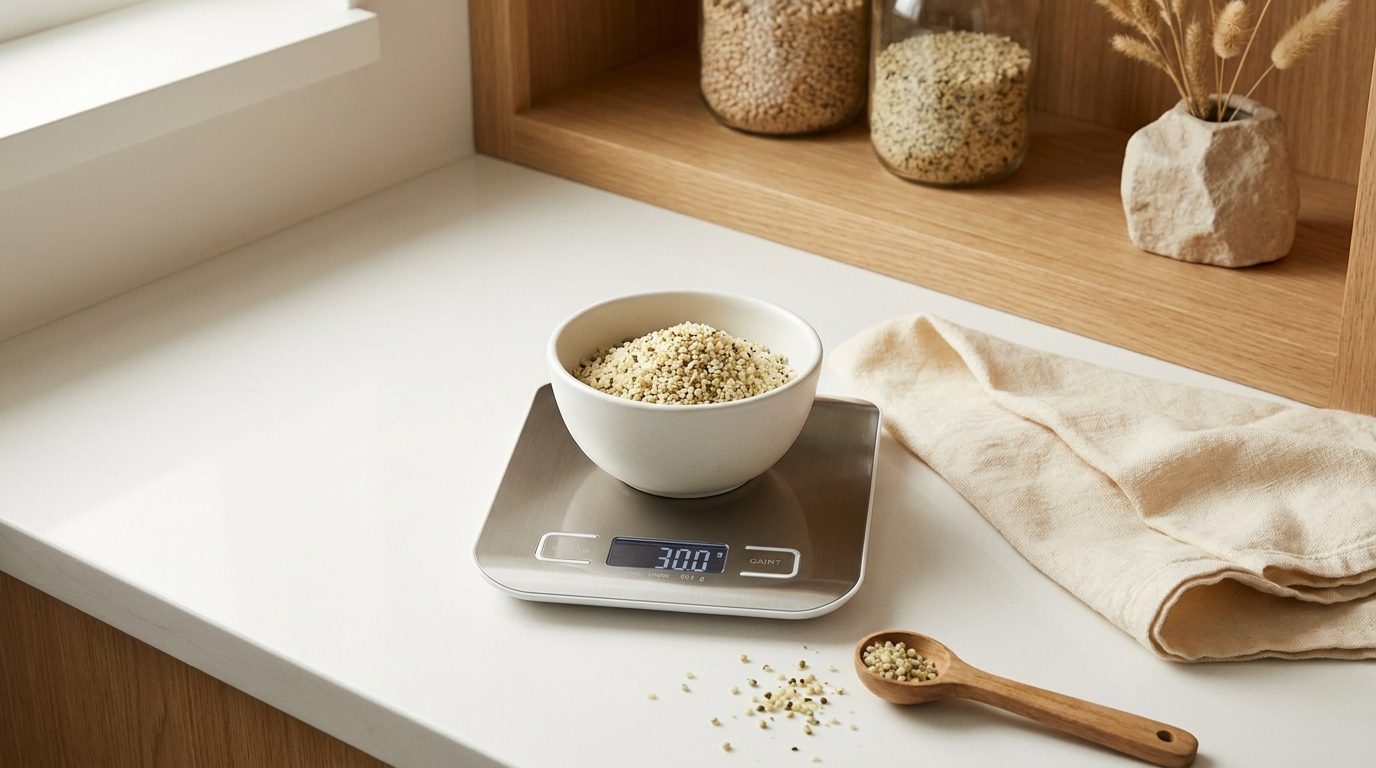
Hemp hearts are calorie-dense, which is exactly why the question feels urgent — but density is not the same as "fattening." Whether they add weight comes down to how much you eat and what those calories replace, and the math is friendlier than the worry suggests.
So, are hemp hearts actually fattening?
No food makes you gain weight on its own. Weight gain happens when you consistently take in more energy than you burn, over weeks and months — not because one ingredient is inherently fattening. Hemp hearts (the soft inner kernel of the hemp seed) are energy-dense because they are roughly two-thirds fat and protein by weight, and fat carries more than twice the calories per gram of carbohydrate or protein. That density is the entire reason a small seed packs real calories.
But density cuts both ways. The same fat and protein that make hemp hearts calorie-rich also make them filling, and a normal serving is small — a tablespoon or two stirred into something, not a bowlful. Used that way, hemp hearts are far more likely to help you feel satisfied than to quietly pad your waistline. The risk is not the seed; it is treating a concentrated food like a free topping and pouring it on by the handful.
The calorie math: how many calories are in hemp hearts?
A standard serving of hemp hearts is about three tablespoons, and that serving lands in the range of roughly 160 to 170 calories. Working backwards gives you a simple rule of thumb you can apply to any recipe:
| Portion | Approximate calories | Realistic use |
|---|---|---|
| 1 teaspoon | ~18 kcal | A light dusting on toast |
| 1 tablespoon | ~55 kcal | A modest sprinkle on yogurt or salad |
| 2 tablespoons | ~110 kcal | A generous topping or smoothie add-in |
| 3 tablespoons | ~160–170 kcal | A full serving; a meaningful protein boost |
| 1/4 cup (~4 tbsp) | ~220 kcal | Larger than most people need at once |
For comparison, a single tablespoon — around 55 calories — is less than a typical slice of bread and similar to a small handful of most nuts or seeds. The number only becomes a problem at the bottom of that table, where casual over-pouring starts to add up. If you find yourself reaching past a quarter cup in a sitting, you are no longer using hemp hearts as a garnish; you are using them as a meal, and the calories should be counted that way.
What portion is sensible — and where does it tip into weight gain?
A practical daily range for most adults is one to three tablespoons. That delivers a worthwhile dose of complete plant protein, fibre, magnesium and healthy fats while keeping the calorie cost between roughly 55 and 170 calories — small enough to fold into almost any eating pattern without disrupting it.
The tipping point is not a magic number of tablespoons; it is whether the calories are added or swapped:
- Added on top: If you keep eating everything you already ate and pile hemp hearts on as a bonus, you have created a calorie surplus. Do that daily with a heaped quarter cup and you could add a few hundred extra calories a day — enough to nudge the scale upward over time.
- Swapped in: If hemp hearts replace something — croutons, sugary granola, a second slice of toast, a less satisfying snack — the net calorie change is small or even negative, because the protein and fat help you eat less elsewhere.
In other words, the same two tablespoons can be weight-neutral or weight-gaining depending entirely on the context around them. The food does not decide; the substitution does.
Why hemp hearts can actually help with weight control
Calorie density gets the headlines, but the more useful story for weight is what hemp hearts do to your appetite. Three properties work in your favour:
- Protein and satiety: Hemp hearts supply complete plant protein with all nine essential amino acids. Protein is the most satiating macronutrient, meaning it blunts hunger more effectively than the same calories from carbohydrate or fat alone — so a protein-rich topping can reduce how much you eat later.
- Fat slows things down: The fats in hemp hearts slow stomach emptying, which helps smooth out the energy from a meal and keeps you fuller for longer rather than spiking and crashing.
- They upgrade what they touch: Stirred into plain yogurt, oatmeal or a salad, hemp hearts turn a snack that leaves you hungry into one that holds you over — often cutting total intake across the day even though the topping itself has calories.
This is why dietitians rarely worry about a tablespoon of seeds. The concern in weight management is almost always the large, easy-to-overeat, low-protein foods — not concentrated whole foods used in small amounts. If you want the broader picture of how hemp fits into an eating pattern built around appetite and protein, the rest of our article library covers meal planning, fibre and protein goals in more depth.
How to use hemp hearts without the calories adding up
The whole game is keeping portions honest and making hemp hearts earn their place rather than just adding to the pile. A few habits make that automatic:
- Measure for a week. "A sprinkle" drifts upward fast. Spoon out a tablespoon or two until you can eyeball the real amount — most people are surprised how much they were pouring.
- Swap, do not stack. Let hemp hearts take the place of a higher-calorie or less filling ingredient — sugary granola, candied nuts, croutons, a drizzle of dressing — instead of joining them.
- Pair with volume, not more density. Hemp hearts shine on high-water, high-fibre foods: berries, leafy salads, vegetable bowls, plain yogurt. These fill the plate without much energy, so the seeds add nutrition rather than excess.
- Count them when the portion is large. A teaspoon on toast is a rounding error. A quarter cup blended into a smoothie is a real ingredient and belongs in your day's tally if you are tracking.
- Use them where protein is otherwise low. A carb-heavy breakfast or a light salad benefits most, because the satiety payoff per calorie is highest there.
The bottom line on hemp hearts and weight
Hemp hearts will not make you gain weight at the portions people normally eat them — a tablespoon or two on something is a modest, nutrient-dense addition, not a diet-wrecker. They only become a weight problem if you treat a concentrated food like a freebie and pour quarter cups onto meals that were already complete. Decide on one to three tablespoons a day, keep them swapping in for something rather than stacking on top, and lean on their protein and fat to do the real work — feeling satisfied on fewer total calories. Used that way, the food most people fear will quietly help, not hurt.