
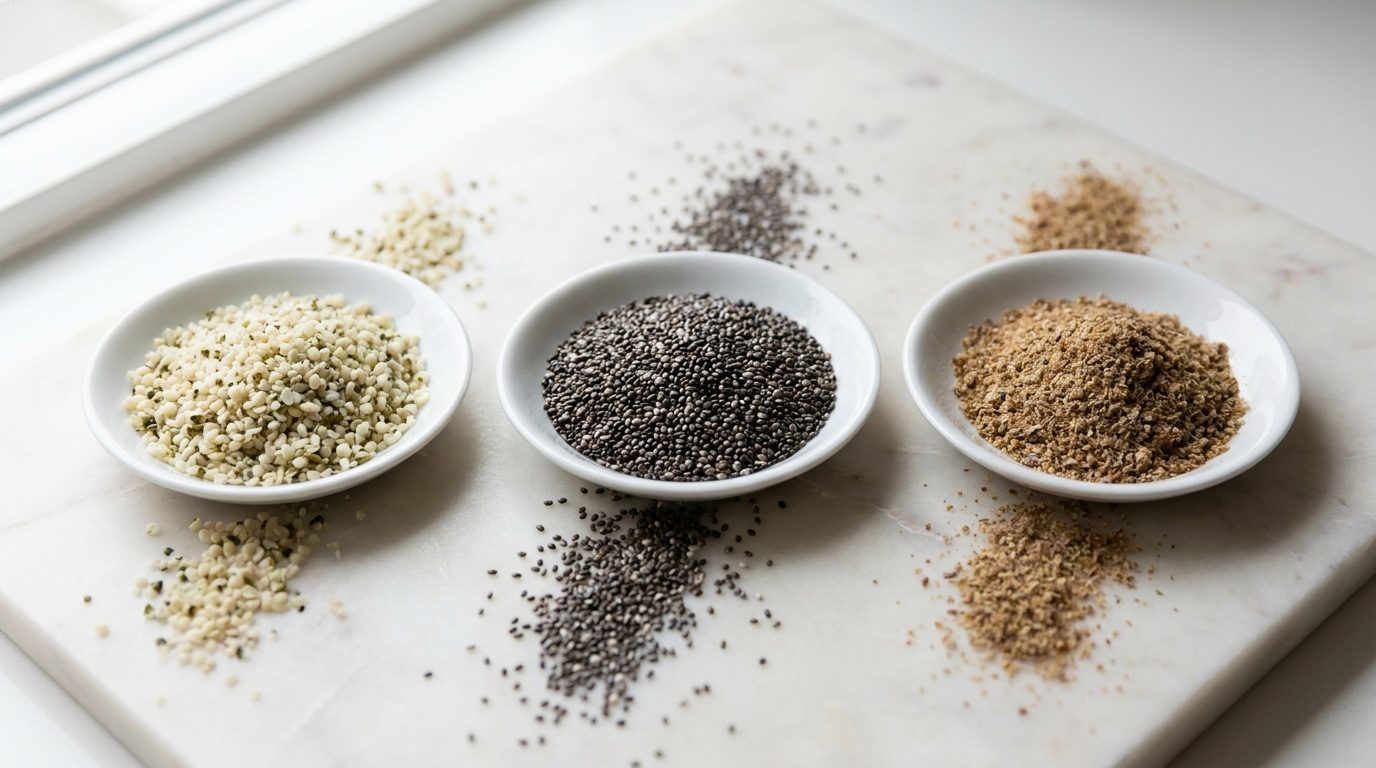
Hemp hearts, chia and ground flax end up on the same shelf in most plant-based kitchens, and plenty of people own all three while using none of them well. The differences between them are mechanical and practical, not philosophical.
What each seed is actually for
Hemp hearts are the soft inner kernel of the hemp seed with the hull removed. They are mildly nutty, need no grinding and no soaking, and behave like a very small, soft nut. Chia is a hard little seed whose defining property is that it absorbs many times its weight in liquid and turns gelatinous within minutes. Flax is a hard seed that passes through the gut largely intact unless it is ground, after which it becomes a fine meal that thickens whatever it lands in.
That mechanical difference settles most of the argument before nutrition enters it. Hemp goes on top of finished food. Chia sets puddings and thickens fruit. Flax binds baking and bulks up porridge. Buy all three expecting interchangeable sprinkles and two bags will go stale in the cupboard.
Protein: only one of the three is a serious contributor
Per 30 grams, roughly three tablespoons, hemp hearts supply somewhere around ten grams of protein, which is genuinely useful in a diet where protein arrives in small instalments rather than in slabs. Chia and flax land closer to four to six grams for the same weight, and in practice almost nobody eats 30 grams of either one. A tablespoon or two is the normal dose, so their real contribution is a couple of grams.
If protein is the reason you are buying seeds at all, that gap is the entire story. Hemp hearts can anchor a meal. Chia and flax contribute protein only incidentally, on the way to doing something else.
Omega-3s: flax leads, with an asterisk
All three seeds supply alpha-linolenic acid, the plant form of omega-3. Flax is the most concentrated source per gram, chia sits close behind, and hemp supplies less ALA but arrives with a comparatively balanced ratio of omega-6 linoleic acid to omega-3, plus a small amount of gamma-linolenic acid the other two do not offer.
The asterisk applies to all three equally. The body converts ALA into the long-chain omega-3s EPA and DHA inefficiently, and conversion to DHA in particular is poor. Seeds are a sensible way to keep ALA intake respectable, but none of them substitutes for a direct EPA and DHA source if that is your specific concern. Choosing flax over hemp because it has more omega-3 only matters if ALA itself is the thing you are chasing.
Fibre and digestion: chia and flax do the heavy lifting
Hulled hemp hearts are low in fibre, around a gram per 30 gram serving, because the fibre lived in the hull that was removed to make them palatable. Chia and flax are the opposite. Both are dense in fibre, much of it the viscous gel-forming kind, which is why both have a reputation for shifting sluggish digestion and why both cause discomfort when someone starts with three tablespoons on day one.
This is the clearest division of labour on the shelf. If the problem you are solving is regularity or total fibre, hemp hearts are the wrong tool and ground flax or soaked chia is the right one. If the problem is protein and texture with no digestive drama, hemp is the right one.
Prep, storage and how each seed fails
- Flax must be ground. Whole flax mostly passes through undigested, and once ground it oxidises quickly, so buy small amounts and refrigerate them.
- Chia must meet liquid. Eaten dry by the spoonful it is unpleasant, and it needs ten to fifteen minutes of soaking to do its job.
- Hemp needs nothing. No grinding, no soaking, no heating, which is exactly why it survives contact with a real weekday morning.
- All three are fragile. These are polyunsaturated fats. Keep opened bags sealed and cold, and trust your nose: rancid seeds smell faintly of old paint and belong in the bin.
How to run all three without waste
Give each seed one job and one storage spot. Hemp hearts live in the fridge door for daily use on oats, yogurt, salad, soup and avocado toast. Ground flax lives beside the oats and goes into porridge, pancakes and any baking that needs binding. Chia lives with the baking supplies and comes out for overnight puddings and thickened fruit, which are worth making in a batch rather than a single serving.
Bought in that order of frequency the quantities look after themselves: a large bag of hemp hearts, a smaller bag of flax, a small bag of chia. For deeper breakdowns of hemp food by food, the rest of the article library covers it. And if you will only ever keep one of the three in the house, keep hemp hearts, not because they win on every measure but because they are the only one requiring no preparation, no waiting and no adjustment period, which makes them the one you will actually eat.