
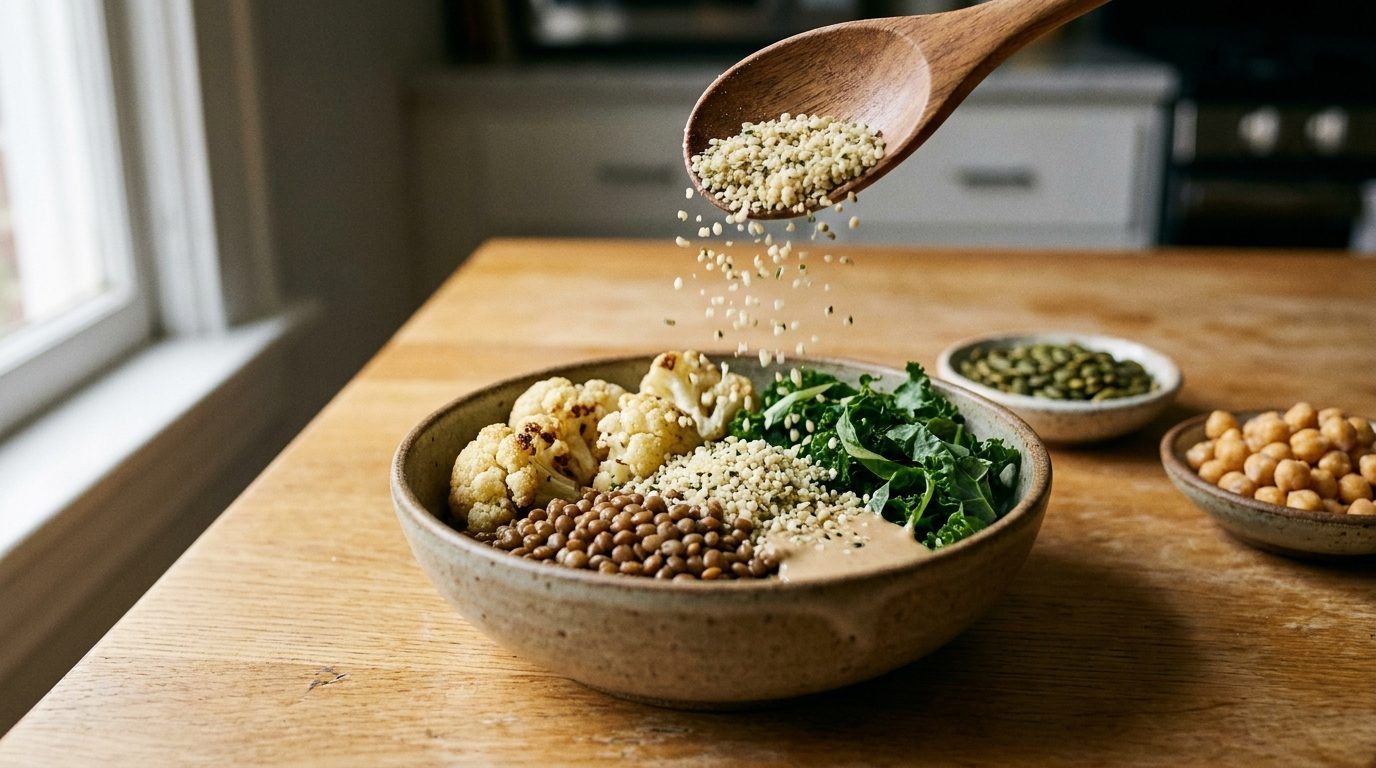
Most vegan meal plans quietly assume soy. Take tofu, tempeh, edamame and soy milk out and the protein column collapses. Hemp cannot replace all of that on its own, but it can take a serious share of the load.
Why people end up avoiding soy
The reasons vary and they are not all equal. A diagnosed soy allergy is absolute and requires vigilance about hidden soy in sauces, breads and processed foods. Some people find soy foods genuinely hard to digest. Others avoid soy on the strength of internet claims about hormones that mainstream dietary guidance does not support. Whatever the reason, the practical consequence is identical: you have to rebuild the protein backbone of your diet out of other parts.
That backbone has three realistic legs. Legumes, meaning lentils, chickpeas, beans and peas. Grains and pseudograins, meaning oats, wheat, quinoa and rice. And seeds and nuts, where hemp does its best work.
What hemp actually contributes
Hulled hemp seed, sold as hemp hearts, delivers roughly ten grams of protein per 30 gram serving, alongside about fifteen grams of predominantly polyunsaturated fat. It contains all nine essential amino acids, and unlike most seeds it needs no cooking, grinding or soaking, so it can be added to food that is already made.
Hemp protein powder is the more concentrated option, typically landing somewhere between twelve and fifteen grams of protein per 30 gram scoop with far less fat and a useful amount of retained fibre. It is coarser and earthier than soy or pea isolate, which matters more in water than in a banana smoothie.
Neither form is a like-for-like tofu replacement, because tofu is a centre-of-plate ingredient and hemp is not. Hemp is a topping, a binder and a smoothie base. Recognising that is what stops you from cooking disappointing hemp steaks.
Building a soy-free day that hits the numbers
Assume an adult aiming for somewhere between 1.2 and 1.6 grams of protein per kilogram of body weight, which is the range usually discussed for people eating mostly plants, since plant proteins are generally less digestible than animal ones. For a 70 kilogram person that is roughly 85 to 110 grams a day. A soy-free structure that reaches it looks like this.
Breakfast carries oats with three tablespoons of hemp hearts and either a nut butter or a pea-protein milk, landing somewhere near 20 grams. Lunch is a lentil or chickpea base, which brings 15 to 18 grams from a generous cup of cooked legumes, plus whole grain bread or a grain salad for another 6 to 8. Dinner repeats the legume-plus-grain pattern with a different personality, perhaps black beans and rice or a chickpea curry. A hemp smoothie or a hemp-heavy yogurt bowl fills any remaining gap in the afternoon.
The gaps you have to cover deliberately
Removing soy removes more than protein, so a few things need attention.
- Lysine. Soy is unusually lysine-rich for a plant food. Hemp is comparatively low in lysine, so legumes have to carry that job. Eat them daily, not occasionally.
- Calcium. Fortified soy milk is a major calcium source in many vegan diets. If it goes, choose a fortified alternative milk and shake the carton, and lean on tahini, almonds, fortified juice and calcium-set greens.
- Convenience. Soy provides most of the ready-made vegan protein in a supermarket. Without it, more cooking is required, which is a scheduling problem before it is a nutrition problem.
- B12 and vitamin D. Unrelated to soy, but a plant-based diet needs a reliable source of both regardless of how you handle protein.
Five soy-free hemp habits worth keeping
Blend hemp hearts into pasta sauce or soup for body and protein without changing the dish. Make a hemp pesto with hearts standing in for pine nuts. Keep a jar of hemp hearts on the table so every bowl gets a spoonful without a decision being made. Whisk hemp oil into vinaigrettes, but never cook with it, since it is delicate and unhappy with heat. And build one smoothie a day around hemp protein powder with banana and oats, which is the single easiest way to add 20 grams without cooking anything.
Start by auditing one ordinary week: write down every meal and mark where soy was doing the protein work. Usually there are only three or four such slots, and each one needs a specific replacement rather than a general intention. Fill two of them with legumes and one with hemp, then check whether the day still adds up. If it does not, the answer is almost always a fourth eating occasion rather than a bigger dinner.